
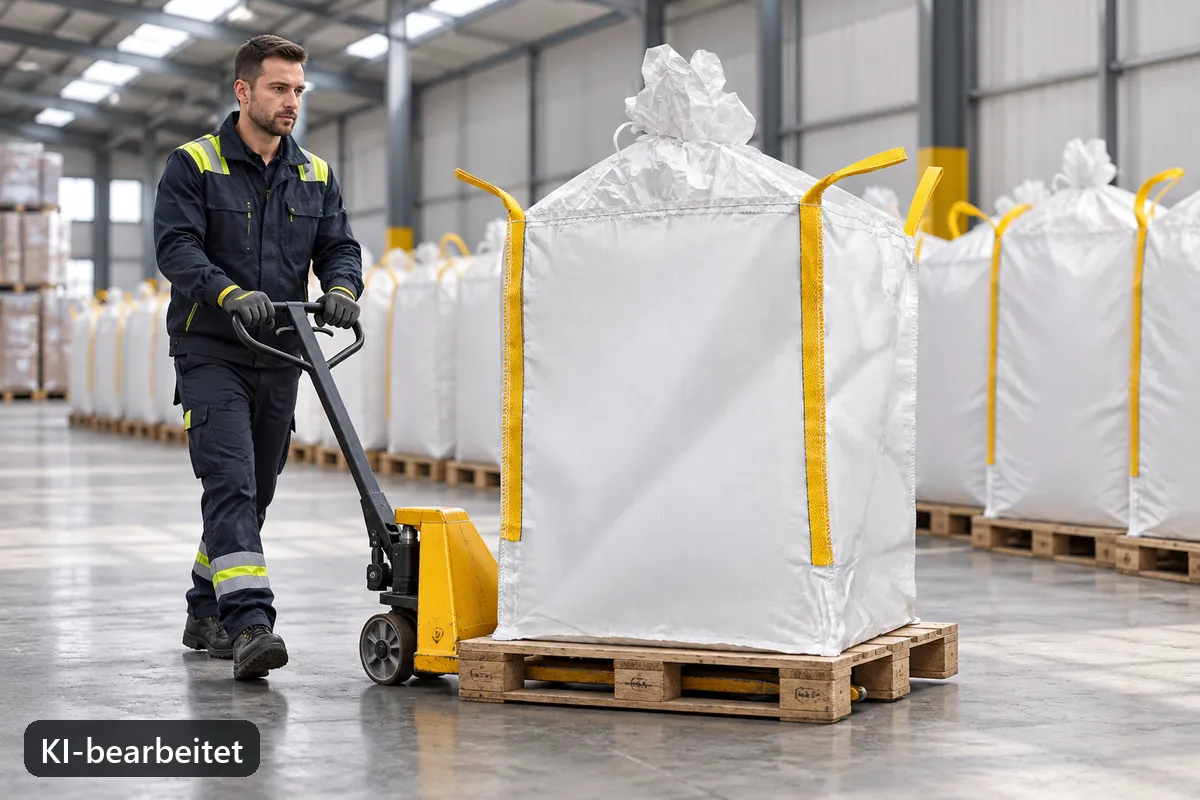
Most damage to big bags occurs not in the material but in handling. These rules are general practice; the label on the bag and the data sheet take precedence.
Check before use
- Inspect the bag, loops and seams for damage. Do not use a damaged bag.
- Check that item, load capacity and print suit the application (label and data sheet).
- Have the skirt, lid or closing strap ready.
Filling
- Do not fill beyond the load capacity (SWL); determine the fill height in advance. Example: BB90T with sand at most up to about 82 cm of 110 cm.
- Distribute the material evenly; do not drop it in from a great height.
- Do not let sharp-edged material strike the fabric; it loads it at points.
- Close the skirt or lid after filling if dust is to be retained.
Lifting and moving
- Always attach to all four lifting loops (on sheet bags to the circumferential straps, on container bags to the crane eye).
- Lift evenly and without jerking.
- Do not stand under a suspended load.
- Do not drag across the ground and do not pierce the bag with a fork.
- Lifting equipment and lifting accessories must be rated for the weight of the filled bag.
Transporting and loading
Filled bags stand more stably when they are full and evenly filled and stand on a level surface. When loading, secure the load so that nothing slips. For hazardous waste, the requirements of waste law and dangerous-goods law apply as well (see Asbestos and mineral wool). Our items are not designated as UN packaging.
Storing
- Store as dry as possible and protected from UV light: polypropylene fabric ages in sunlight.
- Store unused bags in their original packaging. The data sheets give pallet and bundle dimensions, for example BB90T with 500 pieces per pallet in 10 bundles of 50 pieces.
- Stack filled bags only if the manufacturer provides for it for the item and the stacking height has been checked.
- Coated bags protect against the ingress of moisture; even so, do not leave them standing in the rain permanently.
Emptying
Bags with an outlet (special big bags) are opened over the point of use without cutting the bag open. With bags with a closed bottom, the bag is cut open or tipped, and dust can be released. For hazardous substances, the procedure follows your risk assessment and operating instructions.
Special points for asbestos and mineral wool
With asbestos waste, under TRGS 519 no. 18.1 (3) no dust may be released when picking up and providing it, for example by extraction, consolidation, dampening or covering. The containers stay closed after filling. With old mineral wool (TRGS 521), the low density demands large volume: the bag is full early but stays light. Questions on packaging asbestos waste are answered on the page Asbestos big bags and sacks.
Special points by design
- Big bag and special big bag: four lifting loops; always attach all of them. Also tie special big bags to the filling line at the inlet and close the outlet before lifting.
- Sheet bag: long and flat; the load hangs on two circumferential straps. Lay sheets evenly along the length so that the bag does not hang on one side.
- Container bag: retaining and closing straps hold the bag in the container; the crane eye is used for moving with the crane. Clarify the permitted load and type of attachment in advance.
- PP flat bag: without loops, to be moved by hand. Do not overfill, so that the closing strap or drawcord can be closed.
Typical mistakes
- Attaching to only two loops: loads the fabric on one side and is not covered by the load capacity.
- Filling beyond the load capacity: volume tempts you; weight decides.
- Fork in the bag: fork tines can pierce the fabric and damage the bag.
- Dragging across the ground: damages the fabric and seams at the bottom.
- Permanent storage in the sun: UV weakens the polypropylene fabric.
- Stacking without approval: filled bags may be stacked only if the manufacturer provides for it.
Quick check before lifting
- All four loops undamaged and hooked in?
- Weight of the filled bag less than the load capacity of the bag and of the lifting equipment?
- Material evenly distributed, skirt or lid closed?
- Lifting accessories suitable, lifting path clear?
- Nobody under the load, ground level?
Instruction
Anyone who fills, attaches or moves big bags should be instructed in handling: attaching to all loops, load capacity, ban on standing under a load, what to do with damaged bags. Instruction is part of your company's risk assessment.
Disposal of the empty bag
How empty bags are to be disposed of is determined by your waste disposal company, especially if they contained hazardous substances or carry an asbestos or mineral wool warning print. Ask them before disposal.
Frequently asked questions
May I lift a filled bag by one loop?
No. Always attach to all four lifting loops. With only one or two loops the fabric is loaded on one side; the load capacity does not cover this.
How long may a bag stand outdoors?
The data sheet gives no time limit. Polypropylene fabric ages in sunlight, so: do not store permanently in the sun, move filled bags promptly and cover them for longer storage.
May I stack filled bags?
Only if the manufacturer provides for it for the item and the stacking height has been checked. Without that information, do not stack.
Sources and date
- General practice in handling flexible bulk containers. The label on the bag and the data sheet take precedence.
- TRGS 519 (BAuA), version 28 February 2025, no. 18.1 (3): dust release when picking up and providing.
- Item data: product data sheets of DS SafetyWear Arbeitsschutzprodukte GmbH.
As of: 23 October 2026. General technical information, not legal advice. The data sheet, label and the requirements of your waste disposal company or client take precedence.