How the finder works
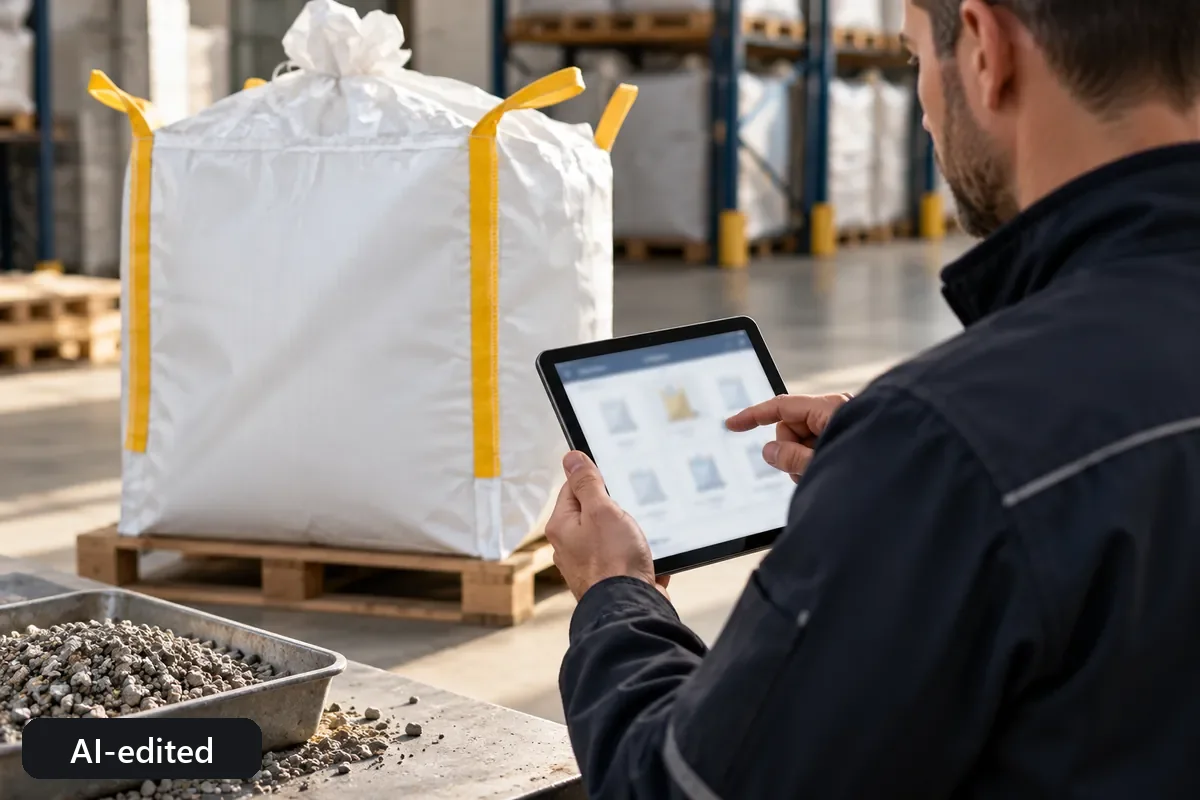
The Big Bag Finder asks three questions and derives a recommendation from them. First: what goes in? Second: how is the sack moved? Third: what are the material and the storage like? At the end it shows up to five items, sorted by match. For each item it states why it fits: for example “four lifting loops for crane and forklift”, “coated fabric against moisture”, load capacity with safety factor and the standard reference from the data sheet. The best match carries the label “Best match” if it stands out from the second.
The recommendation is based exclusively on the information in our product data sheets. It is a guide. Whether an item is suitable for your material, fill height and lifting equipment is something you check in your risk assessment; we are happy to advise.
The nine materials and what the finder makes of them
The chosen material determines the print first. For asbestos waste the finder shows only items with asbestos warning print, for old mineral wool only items with mineral wool warning print, for all other materials neutral items without warning print.
| Material in the finder | Items shown | Note in the result |
|---|---|---|
| Asbestos-containing waste | with asbestos warning print | Obligations under TRGS 519, the Hazardous Substances Ordinance and the acceptance conditions of the waste disposal company |
| Sheets and long components | with asbestos warning print, preferably sheet bags | Long components belong in sheet bags or container bags, not in a standard big bag |
| Old mineral wool | with mineral wool warning print | Low nominal load capacity of 150 to 250 kg; volume is the limiting factor |
| Rubble, excavated material, minerals | neutral | Check the fill limit, do not drop material in from a great height |
| Bulk material with inlet and outlet | neutral | Inlet and outlet (swan neck) for controlled filling and emptying |
| Flood and emergency | neutral | Flood is named as an area of use for small and medium big bags |
| Food and feed | neutral, as a starting point | Special solution on request: not designated as food packaging |
| Chemicals, powders, dangerous goods | neutral, as a starting point | Special solution on request: not designated as UN packaging |
| Metal, swarf, plastic parts | neutral, as a starting point | Special solution on request: robust fabric, liner, special printing case by case |
Handling determines the design
The second question determines the design. The finder works like this:
| Answer | Design in the result | Example |
|---|---|---|
| Crane or forklift | Big bag with four lifting loops; for “Sheets and long components”, a sheet bag | BB90T, BBA260 |
| Lining a roll-off container | Container bag with lid and crane eye | BBA650, BB700 |
| Fill by hand, small quantities | PP flat bag with closing strap or drawcord | PPFBA70, PPFBM140 |
| Empty in a controlled way | Special big bag with inlet and outlet | BBS004 |
The third question concerns storage. For “damp or outdoors” the finder prefers coated fabric; for “dry, covered” uncoated is enough. A skirt that can be tied shut and a standard reference in the data sheet also count in the item's favour.
How the results are sorted
The finder awards points. The design that matches the handling earns the most points, and for “Sheets and long components” sheet bags a little more than standard big bags. For “damp or outdoors”, coated items earn extra points and uncoated items lose points; for “dry, covered”, uncoated is sufficient and gets a small bonus. A skirt that can be tied shut also counts. With equal points, the item with the higher load capacity comes first. The points are not a quality judgement; they only rank the fit to your three answers.
Three examples
Fibre cement corrugated sheets by crane: material “Sheets and long components”, handling “Crane or forklift”, storage “damp or outdoors”. The finder leads to the sheet bags BBA260, BBA261, BBA320 and BBA321, all coated, with 1,500 kg load capacity.
Bulky mineral wool by hand: material “Old mineral wool”, handling “Fill by hand”. The result is PP flat bags with mineral wool warning print such as PPFBM140 (140 × 220 cm, drawcord in the hem).
Sand with controlled outlet: material “Bulk material with inlet and outlet”, handling “Empty in a controlled way”. The finder shows the special big bags with outlet BBS001, BBS002, BBS003 and BBS004. Whether the spout dimensions suit your plant is stated in the technical data.
After the finder
The result is a starting point. Open the product page of the recommendation, check dimensions, load capacity and data sheet and recalculate the fill height in the calculator. Save the items with the heart and send them with your enquiry. We reply with an item suggestion, data sheets and a quotation.
What the finder cannot do
- It does not calculate fill quantities. For that there is the Fill Limit Calculator.
- It does not replace legal advice or advice from competent persons.
- It knows only standard items. For special solutions it leads to the enquiry or to the configurator.
- It does not check whether your waste disposal company or acceptance point accepts the packaging.
Frequently asked questions
Why does the finder show no item for my combination?
Because we carry no standard item for this combination. Describe your needs in the configurator or in the enquiry, and we will examine a custom-made product.
Why is “special solution” noted for food, chemicals and metal?
Because the standard range is designed for disposal and remediation and is designated neither as food packaging nor as UN packaging. The items serve as a starting point for a specification.
Can I save the results?
Yes. With the heart next to each item you put it on the shortlist and later send it with the enquiry. Your browser stores the shortlist locally; it is not transmitted to us.