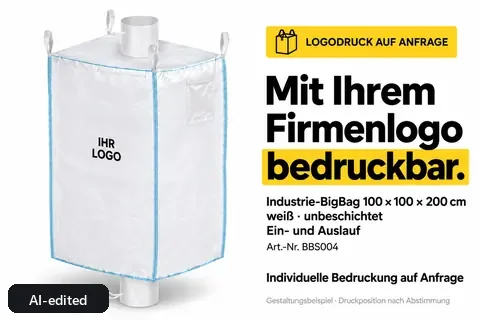
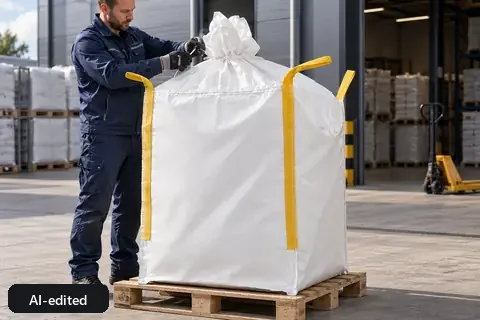
BBS004 · Special big bag
100 × 100 × 200 cm
PU 200 pieces per pallet
Industry
Chemical materials demand more than load-bearing strength: compatibility, dust-tightness, electrostatic behaviour and, where applicable, an approval for dangerous goods. The items in this overview are not designated as UN packaging for dangerous goods. For chemicals we work out a specification with you.

We clarify bulk density, dust behaviour, compatibility and filling process before we specify fabric and liner.
Big bags with swan-neck inlet and outlet (e.g. BBS004, 1,250 kg load capacity) as a starting point for adaptations.
We agree test certificates and conformity documents to your requirement.
What we clarify with you
These points decide whether and how a big bag comes into question for your material. We collect them in conversation and record them in the specification.
For dangerous goods, a UN approval of the packaging under ADR/RID is required (for big bags made of plastic fabric, packaging codes of group 13H). This is an approval in its own right and not part of this item overview.
For combustible dusts or solvents, the type of big bag (A, B, C or D under IEC 61340-4-4) determines the permitted filling and emptying environment. Without special antistatic equipment, a big bag corresponds to type A.
PE liner, if necessary barrier films against moisture, oxygen or aroma.
Tight seams, seam covering, spouts with closure.
Chemical resistance of polypropylene fabric and liner to the material and cleaning agents.
Starting point
These items are not an approved industry solution. They show the constructions on which we build.
BBS004 · Special big bag
PU 200 pieces per pallet
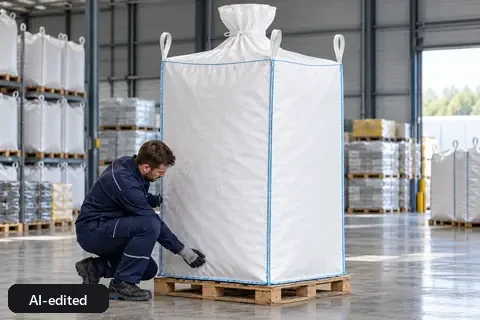
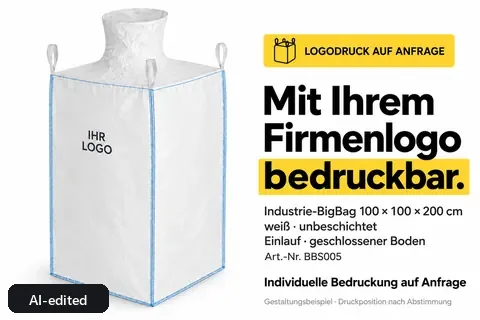
BBS005 · Special big bag
PU 220 pieces per pallet
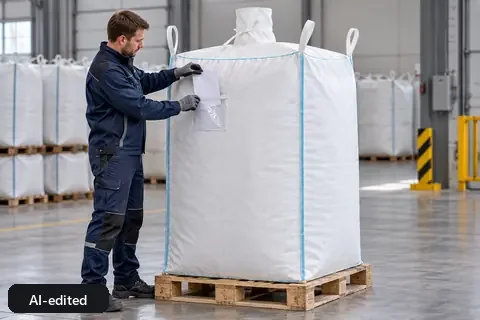
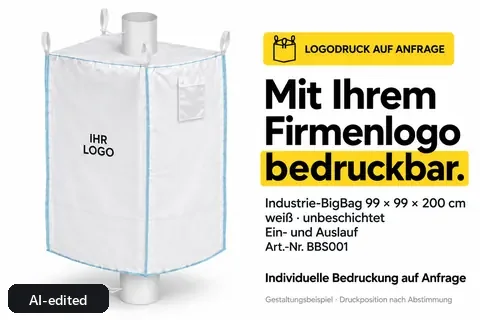
BBS001 · Special big bag
PU 170 pieces per pallet
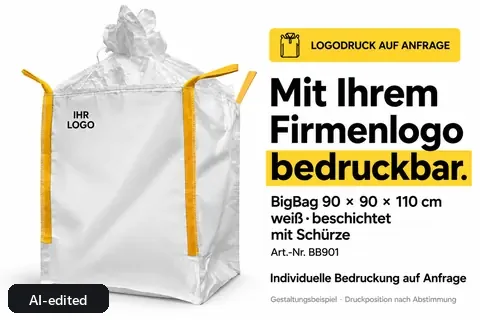
BB901 · Big bag
PU 300 pieces per pallet
In these sizes we carry several versions, which a separate page compares side by side: Special big bag 100 × 100 × 200 cm, Big bag 90 × 90 × 110 cm.
Points to note before use
For dangerous goods the packaging must be approved under ADR/RID; for big bags made of plastic fabric, with packaging codes of group 13H. This is an approval in its own right, with type testing and marking on the bag. The items in this overview are not designated as UN packaging. For dangerous goods you must therefore clarify a specification with approved packaging with us before you use an item. Whether a substance counts as dangerous goods is stated in the safety data sheet and in the classification under ADR.
For combustible dusts or solvent vapours, the electrostatic type of the big bag (IEC 61340-4-4) determines the permitted filling and emptying environment:
| Type | Property | Use |
|---|---|---|
| A | no special antistatic equipment | only for non-combustible material in a non-explosive environment |
| B | fabric with limited breakdown voltage | combustible dusts, no combustible solvent vapours |
| C | conductive fabric, must be earthed | earthing during filling and emptying is mandatory |
| D | dissipative fabric, discharge without earthing | use only after checking the requirements |
A big bag without special equipment corresponds to type A. We do not carry dissipative types in the standard range. Ignition hazards from dusts and solvents are always assessed by the company in its explosion protection assessment.
The special big bags BBS004 (inlet and outlet, 1,250 kg load capacity), BBS005 (inlet only) and BBS001 serve as starting points for adaptations, plus the coated big bag BB901 with 1,250 kg load capacity. All have 4 lifting loops and polypropylene fabric. For fine, dusty powders, seams, seam covering and spouts with closure play a role; for moisture-sensitive substances, PE liner or barrier films.
Send us the material, safety data sheet, filling and emptying process and the required certificates via the enquiry form, or put together a specification in the Bag Configurator. We agree test certificates and conformity documents to your requirement. Until a specification has been approved, the rule is: do not fill dangerous goods into items of the standard range.
A big bag without antistatic equipment corresponds to type A. With combustible dusts or solvent vapours it is permitted only after the company's explosion protection assessment. We do not carry dissipative types in the standard range; we clarify them case by case.
Not in the standard range. For dangerous goods the packaging needs its own approval (for fabric big bags, codes of group 13H). For this we work out a specification with you.
With safety data sheet, bulk density, grain size, dust behaviour, temperature and the filling and emptying process. From this we derive fabric, liner and spouts.
As of: 23 October 2026. German original technically reviewed by Dennis Alexandrakis on 23 October 2026; this English version is a translation of it. General technical information, not legal advice. The item's data sheet, the regulations cited and the requirements of your client or waste disposal company are authoritative.
Enquiry
Found the right item, or have a special request?
Save items with the heart or describe your needs. We reply with an item suggestion, data sheets and a quotation.
A brand of DS SafetyWear
The brand family of DS SafetyWear Arbeitsschutzprodukte GmbH
Every brand leads in its category. ProSafe Big Bag is the brand for big bags and sacks.