
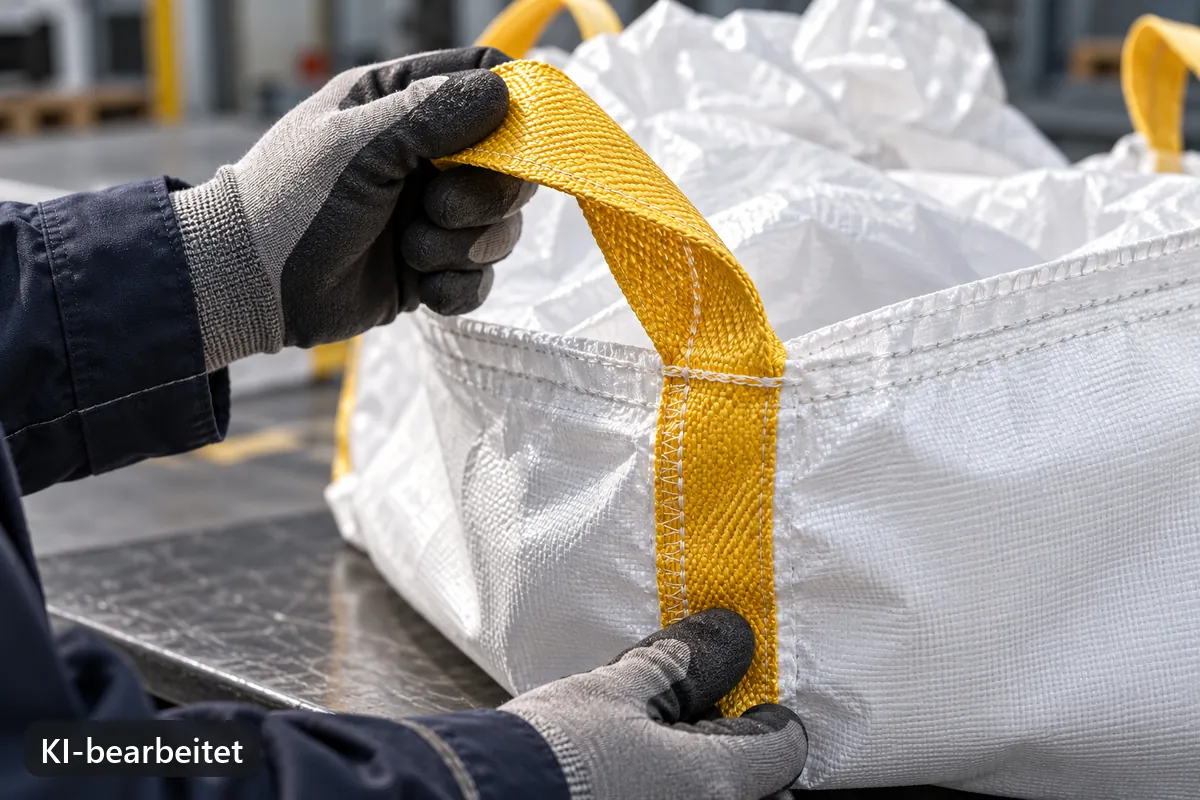
The components at a glance
- Fabric: polypropylene tape fabric. The weight per unit area in g/m² (GSM) is one of the features of strength.
- Coating: a thin plastic layer on the fabric makes it tighter against moisture and dust.
- Lifting loops: four webbing loops at the corners. Our data sheets give four lifting loops for big bags, and for sheet bags four loops on two circumferential straps.
- Top: open, with skirt (can be tied shut), with lid (container bag) or with inlet (swan neck).
- Bottom: closed (flat bottom) or with an outlet for emptying.
- Seams: the specifications state overlock with an additional safety seam (safety stitch).
- Label: the DS label carries the marking and notes on safe use.
Explore the components on the model on the home page.
Fabric: woven polypropylene tapes
The base material of a big bag is a fabric of polypropylene (PP). Narrow tapes are drawn from the plastic and woven crosswise into a sheet. The result absorbs high tensile forces, is light and sews well. At the same time it is air-permeable as long as it is not coated, and it ages under UV light. Our data sheets give no information on UV stabilisation. For outdoor storage, therefore: protect filled and unused bags from the sun.
The weight per unit area in g/m² is a feature of strength but not the only one. For load capacity and durability, construction, seams and loops count just as much. Our data sheets give these fabric weights:
For many items the data sheet gives no fabric weight. There the product page says “on request” instead of guessing.
Construction: how the fabric is cut
Big bags are distinguished by how the fabric is cut. In the U-panel design, the bottom and two side walls form one piece of fabric in a U shape, and the two remaining walls are sewn on. In the 4-panel bag, each side wall is made from a separate cut; in circular fabric the fabric is woven as a tube and has no vertical side seams. Which construction an item has is not consistently stated in our data sheets. If you need a particular construction for your application, ask for it.
Lifting loops: four points for the load
Our data sheets give four lifting loops for big bags and special big bags. They sit at the corners and are attached together so that the load is spread evenly. On sheet bags the four loops lie on two circumferential straps, which spread the force over the length of the bag. Container bags carry retaining and closing straps and a crane eye (craneye) for moving with the crane instead. Flat bags have no lifting loops and are moved by hand.
Anyone lifting by only two loops loads the fabric on one side. The load capacity does not cover this loading. So the rule is always: attach all four loops.
Top: open, skirt, lid or inlet
- Open, without skirt: BB45T, BB60T, BB90T, BB902T. Quick to fill; the bag stays open at the top. If you want to keep dust in, cover it.
- With skirt: BB70, BB90, BB901, BBA90, BBA90PE, BBA901 and others. The skirt is the extended fabric at the top that is tied shut after filling.
- With lid: container bags, with retaining and closing straps.
- With closing strap or drawcord in the hem: flat bags.
- With inlet (swan neck): special big bags BBS001, BBS002, BBS003, BBS004, BBS005.
Bottom: closed or with an outlet
On most bags the bottom is closed and flat (flat bottom). The bag stands stably and loses no material. On 4 of 5 items, special big bags have an outlet (swan neck) at the bottom that you open over a silo, hopper or mixer. Emptying then needs no cutting open and creates less dust.
Designs in the range
| Design | Typical for | Special feature |
|---|---|---|
| Big bag | Rubble, excavated material, bulk material | 4 lifting loops, 45 to 135 cm edge length |
| Sheet bag | Corrugated sheets, long components | 260 or 320 cm long, load spread over two straps |
| Container bag | Lining roll-off containers | 620 to 750 cm, lid, crane eye |
| PP flat bag | Small quantities by hand | Closing strap or drawcord, optional PE liner |
| Special big bag | Bulk material with controlled emptying | Inlet and outlet (swan neck) |
Sizes and nominal volumes of the big bags
The nominal volume is the product of the external dimensions. The actual fill volume is lower, depending on construction and material.
| External dimensions (L × W × H) | Nominal volume | Items |
|---|---|---|
| 45 × 45 × 60 cm | 0,12 m³ | 1 |
| 60 × 60 × 60 cm | 0,22 m³ | 1 |
| 70 × 70 × 70 cm | 0,34 m³ | 1 |
| 70 × 70 × 90 cm | 0,44 m³ | 1 |
| 90 × 90 × 110 cm | 0,89 m³ | 10 |
| 125 × 125 × 150 cm | 2,34 m³ | 1 |
| 135 × 135 × 130 cm | 2,37 m³ | 2 |
From construction to selection
- Do you know what is to go in the bag? Then the Big Bag Finder helps in three questions.
- Do you know how heavy the material is? The Fill Limit Calculator shows the permitted fill height.
- Do you want to go through all the questions before ordering? The checklist has eight of them.
- Do you need a version that does not exist? The Bag Configurator turns it into a specification.
Sources and date
- Item data: product data sheets of DS SafetyWear Arbeitsschutzprodukte GmbH (dimensions, fabric weight, lifting loops, top, bottom).
- EN ISO 21898: flexible bulk containers (FIBC).
As of: 23 October 2026. General technical information, not legal advice. The data sheet, label and the requirements of your waste disposal company or client take precedence.