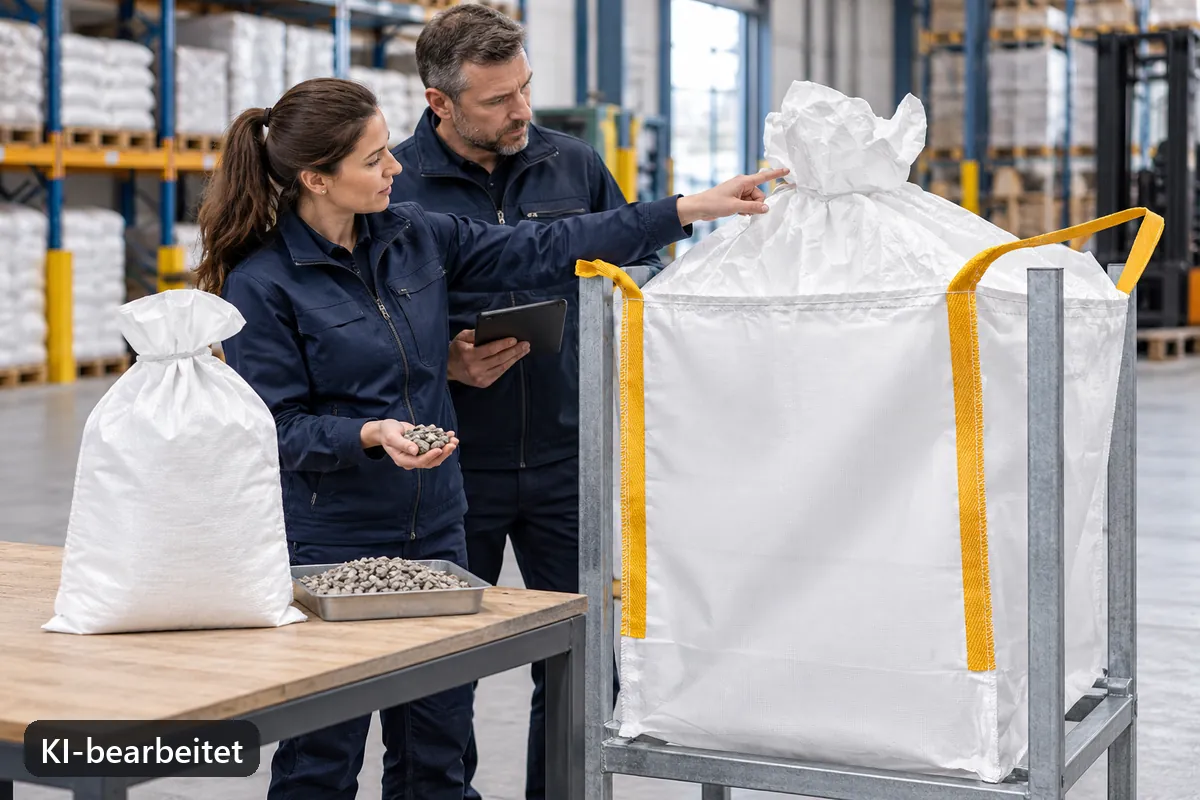
The eight questions follow the path from material to evidence. For each question it says what it means and how to recognise the answer in the data sheet.
- Which material? Type, grain size, bulk density, sharp-edged or fine, dry or damp. The bulk density determines how heavy the bag gets. Sand is at about 1.50 t/m³, rubble at 1.40, mineral wool at 0.10. If you do not know the density, weigh a test container of known volume.
- Which weight? Bulk density × volume. The Fill Limit Calculator helps. You compare the result with the item's load capacity (SWL): BB90T carries 1,000 kg, BB902T 1,500 kg, BB45T 500 kg.
- How is it filled and emptied? Open from the top, via an inlet, emptying by cutting open or via an outlet. If you want to empty in a controlled way, you need a special big bag with swan neck, for example BBS004 with inlet and outlet.
- How is it moved? Crane, forklift, container. Sheet bags and container bags have their own ways of attachment. With big bags you always attach all four lifting loops, with sheet bags the straps, with container bags the crane eye. Flat bags are moved by hand.
- Where is it stored? Indoors or outdoors, for how long. Coated fabric protects against moisture; UV light limits the storage time outdoors. Do not store filled bags in the sun permanently.
- Which marking? Neutral, asbestos warning print, mineral wool warning print or special print. 18 items carry the asbestos warning print, 9 the mineral wool warning print. Your own motifs are possible from 5 pallets.
- Single-trip or multi-trip? Safety factor 5:1 for single-trip, 6:1 for multi-trip. The standard range is designed for single-trip use.
- Which evidence? Data sheet, test report, declaration of conformity, waste disposal company approval. Data sheets exist for all items, declarations of conformity for three items (BBA90, BBA901, BBA320); we send the others as soon as they are available.
Do you have the answers? To the Big Bag Finder or configure a custom-made bag.
Example: sand and gravel on a construction site
A company wants to haul sand and gravel away from the construction site by forklift. Material: sand, dry, about 1.50 t/m³, gravel about 1.60 t/m³. Weight: a 90 cm bag holds 0.89 m³ by calculation. With sand that would be 1,336 kg, with gravel 1,426 kg. Both exceed 1,000 kg load capacity. The company chooses either BB90T and fills only to a height of about 82 cm, or BB902T with 1,500 kg and fills it full. It is emptied by cutting open, moved by forklift on all four loops, and stored under cover. Neutral, single-trip, data sheet is enough. The result: BB902T filled full or BB90T up to the fill limit.
Example: corrugated sheets during remediation
A remediation company dismantles fibre cement corrugated sheets. Material: sheets up to 2.5 m long, sharp-edged, asbestos waste. Moving is by crane and forklift. A sheet bag BBA260 (260 × 125 × 30 cm, 1,500 kg load capacity) or BBA261 (45 cm height) fits. The bag carries the asbestos warning print. Before ordering, the company clarifies with the acceptance point which packaging it requires and which maximum weight per bag applies, and reads Asbestos big bags and sacks.
Example: old mineral wool during remediation
A company removes insulation from an existing building, about 20 m³ of loose mineral wool. Material: mineral wool, bulk density about 0.10 t/m³, so light and bulky. Weight: BBM90 (90 × 90 × 110 cm, 150 kg load capacity) holds 0.89 m³ by calculation and weighs only about 90 kg when full. Volume is the limit here, not load capacity. By calculation about 23 bags are enough for 20 m³. Marking: mineral wool warning print. For bulky individual parts and small quantities a flat bag is an option, for example PPFBM140 with 140 × 220 cm and drawcord in the hem. Before ordering, the company clarifies with the waste disposal company which packaging is accepted.
Selection mistakes and how to avoid them
- Confusing volume with weight. A large bag is not automatically a load-bearing bag. Calculate weight from bulk density and volume.
- Reading load capacity as a filling target. The load capacity is the upper limit. Acceptance points may permit less.
- Forgetting the coating. Anyone storing outdoors generally needs coated fabric or must cover the bags.
- Leaving the marking open. Asbestos and mineral wool waste need labelled containers; this is clarified before ordering, not afterwards.
- Asking the waste disposal company too late. Type of packaging and maximum weight per bag differ locally.
- Not reading the data sheet. Where a value is missing or contradictory, it says “on request”. Ask before you order.
What details to include in the enquiry
Material with bulk density, quantity per year or use, handling (crane, forklift, container), storage location and duration, desired marking, acceptance point or waste disposal company. With these details we can suggest an item, enclose data sheets and prepare a quotation.
Planning quantities and pallets
Bags are delivered by the pallet. How many pieces a pallet holds is given for each item: BB90T 500 pieces, BB45T 1,200 pieces, BBA260 280 pieces. Divide your annual requirement by the packing unit and you know the number of pallets. For printing with a company logo, the minimum quantity of five pallets per order and motif applies, so for BB90T that is 2,500 pieces.
After the checklist
Once you have answered all eight questions, usually only two or three items remain. Compare these in the catalogue with the filters for design, warning print, coating and load capacity. Questions on data sheet, load capacity or waste disposal company approval we answer via the enquiry form.
Sizes with several versions
Once you have chosen the size, comparing the versions helps: a separate page puts print, fabric, load capacity, fill quantities and packing unit for each size side by side.
Big Bags: 90 × 90 × 110 cm (10 items), 135 × 135 × 130 cm (2 items)
Container Bags: 620 × 240 × 115 cm (2 items), 650 × 240 × 115 cm (2 items), 700 × 240 × 240 cm (2 items), 750 × 240 × 240 cm (2 items)
PP Flat Bags: 60 × 100 cm (2 items), 70 × 110 cm (4 items), 80 × 130 cm (2 items), 140 × 220 cm (3 items)
Special Big Bags: 99 × 99 × 165 cm (2 items), 100 × 100 × 200 cm (2 items)
Sources and date
- Item data: product data sheets of DS SafetyWear Arbeitsschutzprodukte GmbH.
- Guide values for bulk density: Fill Limit Calculator on this website.
As of: 23 October 2026. General technical information, not legal advice. The data sheet, label and the requirements of your waste disposal company or client take precedence.