
SWL: safe working load
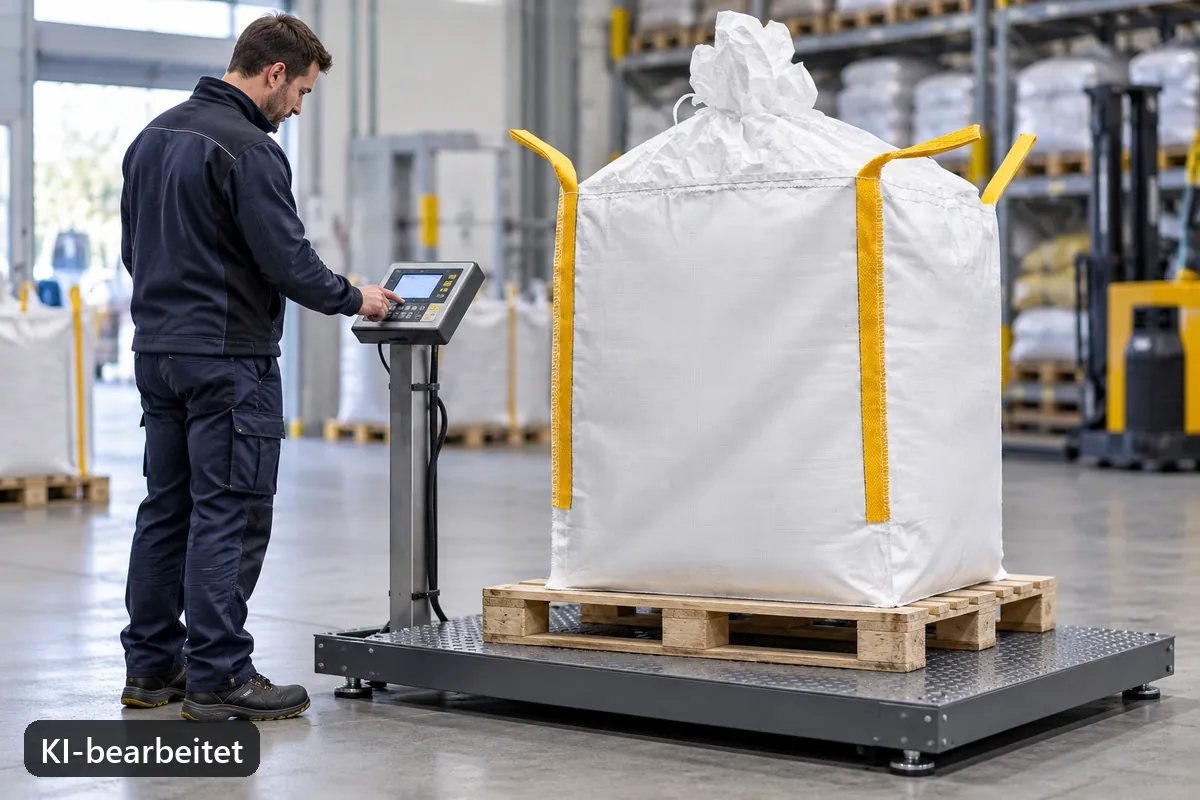
The load capacity (safe working load, SWL) is the permitted payload, that is, the filling weight the manufacturer releases for the big bag. It is given on the data sheet and on the label.
SF 5:1
The safety factor describes the ratio of breaking load to load capacity. For single-trip big bags 5:1 is applied: in a load test the bag must hold at least five times the load capacity. Multi-trip big bags are designed for 6:1. The relevant standard is EN ISO 21898 for flexible bulk containers.
An example from a manufacturer test report (factory laboratory, item BBA90, load capacity 1,000 kg): cyclic test with twice the load over 30 cycles and a peak load test with five times the load. Both tests are documented as passed. We send test reports and declarations of conformity for selected items on request.
Where to find the information
Load capacity and safety factor appear in three places: in the item's product data sheet, on the label on the bag and in the table on the product page under “Technical data”. Where the data sheet contains no clear value or data sheet and specification contradict each other, it says “on request” there, for example for the load capacity of BBS003 and the safety factor of BBA90PE. For container bags and flat bags the data sheets give no load capacity; there the load results from container size, material and handling.
The load capacities in the range
| Load capacity (SWL) | Items |
|---|---|
| 150 kg | BBM90, BBM90T |
| 250 kg | BBM70, BBM125, BBM135 |
| 500 kg | BB45T, BB60T |
| 1,000 kg | BB70, BB90T, BB90, BBA90, BBA90PE, BBA135 |
| 1,250 kg | BB901, BBA901, BBS001, BBS002, BBS004, BBS005 |
| 1,500 kg | BB902T, BBA260, BBA261, BBA320, BBA321 |
The low values belong to the mineral wool bags: old mineral wool is light (guide value 0.10 t/m³), and volume limits the filling long before weight. For rubble and bulk material 1,000 to 1,500 kg are usual; sheet bags carry 1,500 kg.
The weight of your material
Whether a bag reaches its load capacity depends on the material. A 90 × 90 × 110 cm bag holds about 0.9 m³ by calculation. Sand at about 1.5 t/m³ would far exceed the load capacity of 1,000 kg, while mineral wool at about 0.1 t/m³ never reaches it. That is exactly why the mineral wool bags have a load capacity of 150 to 250 kg.
Calculate with your material in the Fill Limit Calculator: it shows the maximum fill height at which the load capacity is respected.
Worked example
BB90T (90 × 90 × 110 cm, 1,000 kg load capacity) holds 0.89 m³ by calculation. With dry sand (1.50 t/m³) the full bag weighs 1,335 kg and exceeds the load capacity. The permitted fill height is 82 cm of 110 cm, that is 75 per cent of the height. The same calculation scheme for BBM90 (90 × 90 × 110 cm, 150 kg load capacity) with mineral wool (0.10 t/m³): when completely full the bag weighs 90 kg, the load capacity of 150 kg is not reached, and the bag is filled to full height. The calculation uses guide values; the measured bulk density of your material is decisive.
Fill heights for three items
The tables show for BB90T (1,000 kg) and BB902T (1,500 kg) up to what height you may fill with typical materials. The calculation uses guide values for bulk density.
| Material (guide value) | Bulk density t/m³ | Weight at full volume | max. fill height | Fill level |
|---|---|---|---|---|
| Sand, dry | 1,50 | 1,335 kg | 82 cm | 75 % |
| Gravel, chippings | 1,60 | 1,425 kg | 77 cm | 70 % |
| Rubble, mixed | 1,40 | 1,245 kg | 88 cm | 80 % |
| Soil, excavated material | 1,60 | 1,425 kg | 77 cm | 70 % |
| Material (guide value) | Bulk density t/m³ | Weight at full volume | max. fill height | Fill level |
|---|---|---|---|---|
| Sand, dry | 1,50 | 1,335 kg | full height (110 cm) | 100 % |
| Gravel, chippings | 1,60 | 1,425 kg | full height (110 cm) | 100 % |
| Rubble, mixed | 1,40 | 1,245 kg | full height (110 cm) | 100 % |
| Soil, excavated material | 1,60 | 1,425 kg | full height (110 cm) | 100 % |
What the load capacity does not cover
- Dynamic loading: shock, swinging, jerk when lifting
- Slanting attachment or lifting by only two loops
- Ageing from UV light and long storage
- Point load from sharp-edged material
The load capacity applies to calm, vertical lifting on all four loops with evenly distributed material. Any deviation reduces the actual reserve. An acceptance point can also permit less than the load capacity: the Stade district, for example, states a maximum of 750 kg per big bag for asbestos waste, even though the bags can carry more.
Frequently asked questions
May I fill a 1,000 kg bag up to 1,000 kg?
Yes, up to the load capacity. The weight of the material, height and distribution must be right, and your acceptance point must not specify less.
Does 5:1 mean the bag may carry five times as much?
No. 5:1 describes the reserve in the test: the breaking load is at least five times the load capacity. In use the load capacity must not be exceeded.
Why is there no load capacity for some items?
Because the data sheet does not state it or data sheet and specification differ. We confirm the value in writing before your order.
Sources and date
- EN ISO 21898: flexible bulk containers (FIBC), safety factors 5:1 and 6:1.
- Manufacturer test report (factory laboratory) for BBA90: cyclic test and peak load test, available on request.
- Guide values for bulk density: Fill Limit Calculator on this website.
- Stade district, leaflet on the delivery of asbestos-containing waste, as of 1/2025.
As of: 23 October 2026. General technical information, not legal advice. The data sheet, label and the requirements of your waste disposal company or client take precedence.