
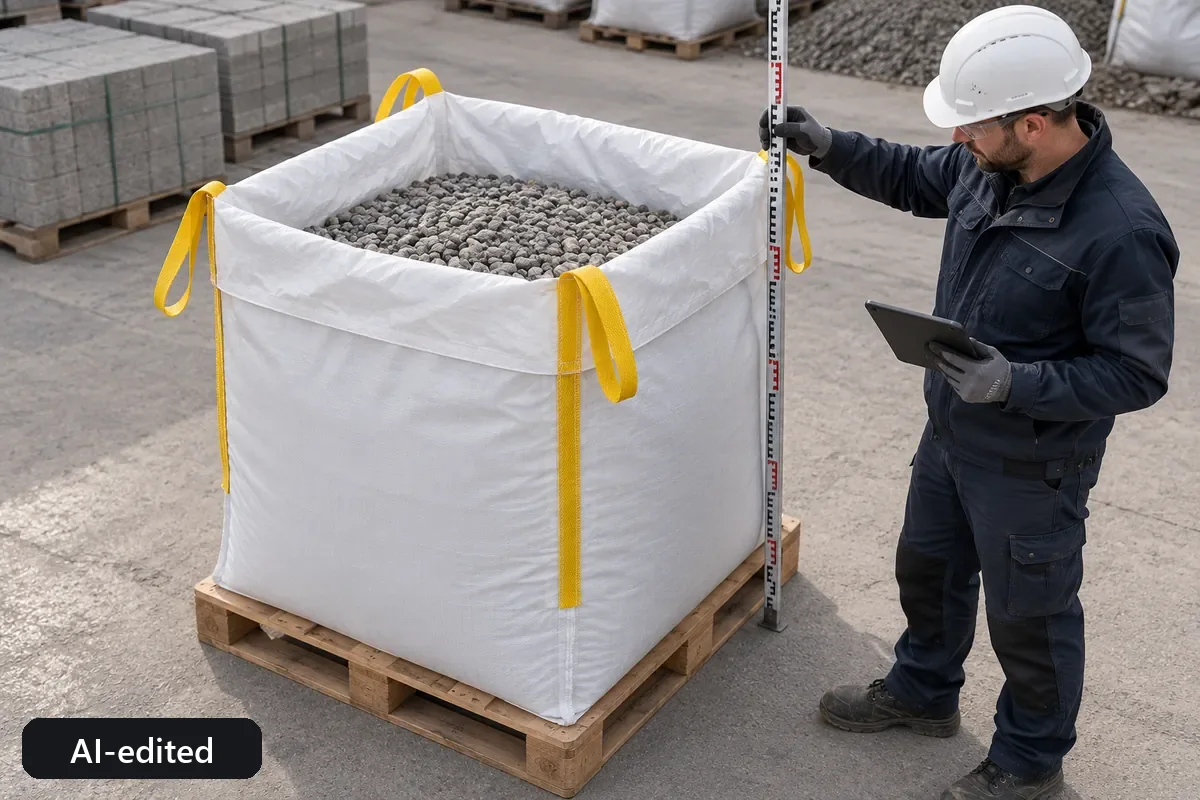
How the calculator works
The calculator answers a simple question: how high may I fill a big bag without exceeding its load capacity? For this it needs the external dimensions of the bag, its load capacity and the bulk density of your material. If you choose an item from the list, the calculator takes dimensions and load capacity from the item data. Alternatively, enter your own values. You choose the bulk density from the guide values or enter it yourself.
- Nominal volume = length × width × height of the external dimensions, converted to m³.
- Weight at full volume = nominal volume × bulk density × 1,000 (in kg).
- Load capacity utilisation = weight at full volume divided by load capacity, in per cent.
- Maximum fill height = load capacity divided by (bulk density × 1,000 × base area), limited to the height of the bag.
If utilisation is above 100 per cent, the calculator shows “Do not fill to the top” and states the fill height up to which the load capacity is respected. If it is below, volume is the limiting factor.
Worked example for BB90T
BB90T measures 90 × 90 × 110 cm and has a load capacity of 1,000 kg. The nominal volume is 0.89 m³. The table shows the result for eight of the calculator's guide values:
| Material (guide value) | Bulk density t/m³ | Weight at full volume | max. fill height | Fill level |
|---|---|---|---|---|
| Old mineral wool, loose | 0,10 | 90 kg | full height (110 cm) | 100 % |
| Wood chips | 0,25 | 225 kg | full height (110 cm) | 100 % |
| Plastic granules | 0,60 | 535 kg | full height (110 cm) | 100 % |
| Cement, loose | 1,20 | 1,070 kg | 103 cm | 94 % |
| Rubble, mixed | 1,40 | 1,245 kg | 88 cm | 80 % |
| Sand, dry | 1,50 | 1,335 kg | 82 cm | 75 % |
| Gravel, chippings | 1,60 | 1,425 kg | 77 cm | 70 % |
| Soil, excavated material | 1,60 | 1,425 kg | 77 cm | 70 % |
With mineral wool and wood chips the bag is full before the load capacity is reached. With sand, gravel, soil and rubble the calculation shows up to what height you may fill. With cement, loose (1.20 t/m³), the weight of the full bag is 1,070 kg, which is above the load capacity.
Comparison: the smaller bag
BB45T (45 × 45 × 60 cm, 500 kg load capacity) holds only 0.122 m³. With sand it weighs 180 kg when full, clearly below the load capacity. Here volume is the limit, and you may fill to full height. This shows why larger bags do not automatically mean more payload: the large bag needs a fill limit, the small one does not.
The guide values for bulk density
| Material | Guide value (t/m³) |
|---|---|
| Old mineral wool, loose | 0,10 |
| Wood chips | 0,25 |
| Plastic granules | 0,60 |
| Cement, loose | 1,20 |
| Rubble, mixed | 1,40 |
| Sand, dry | 1,50 |
| Gravel, chippings | 1,60 |
| Soil, excavated material | 1,60 |
| Grain | 0,75 |
The values vary widely with moisture, grain size and compaction. The measured bulk density of your material is what counts: weigh a test container of known volume, divide the weight by the volume and enter the value in the “Bulk density” field. Grain is listed as a guide value, but the items in the standard range are not designated as food packaging.
Where the calculator reaches its limits
- Nominal volume is not fill volume. Depending on construction and material, the actual volume is lower. The calculator is therefore meant to be cautious.
- Components such as sheets have no bulk density. For sheet bags the weight of the parts counts, not a calculation with bulk density. Container bags and flat bags are not in the calculator's item list because the data sheets give no load capacity for them.
- Dynamic load (shock, jerk) and ageing are not covered by the load capacity.
- Acceptance points may permit less; one example is Stade with a maximum of 750 kg per big bag for asbestos waste.
The calculator replaces neither the data sheet nor your risk assessment.
Checking by hand
You can check the result yourself at any time. Multiply the three external dimensions in metres, for example 0.9 × 0.9 × 1.1 m, to get the nominal volume in m³. Multiply it by the bulk density in t/m³ to get the weight in tonnes. If it is above the load capacity, divide the load capacity by the bulk density and by the base area (0.9 × 0.9 m) to get the permitted fill height in metres.
Frequently asked questions
Why does the calculator show “Volume limited” for mineral wool?
Because old mineral wool weighs only about 0.10 t/m³. A 90 cm bag with 150 kg load capacity is still far below 150 kg when completely full. Volume is the limiting factor.
What reserve should I allow for?
The calculator gives the fill height at which the load capacity is just reached. Plan below that, especially for damp or compacted material, and check your lifting equipment against the actual weight.
Can I use my own dimensions?
Yes. Leave the “Item” field on “Own dimensions and load capacity” and enter length, width, height and load capacity. For custom-made bags the configurator helps.
Where can I find further information on weight?
In the article Safe working load and safety factor with a worked example and fill heights for three items, and on the product pages in the section “Fill quantities”.